Resources
Design Categories:


- Circulation & Paving
- Community Gardens
- Excavation
- Exterior Security
- General Grounds
- On-site Clean Power Generation & Battery Storage
- Parking Lots
- Pedestrian Circulation & Paving
- Planting
- Playgrounds
- Site Amenities
- Site Fences
- Site Lighting
- Site Utilities
- Stairs, Ramps & Railings
- Stormwater Piping & Drainage Structures


- Building Drainage
- Building Sewage System
- Domestic Hot Water (DHW) System
- Domestic Water System
- Geothermal & Ground Source Heat Pumps
- Natural Gas Piping
- Non-Residential Spaces Plumbing Fixtures
- Plumbing General
- Roof Tanks
- Underground Chilled Water Piping
- Underground Hydronic Piping
- Underground Natural Gas Piping
- Underground Water Piping


Waste Yards

Description
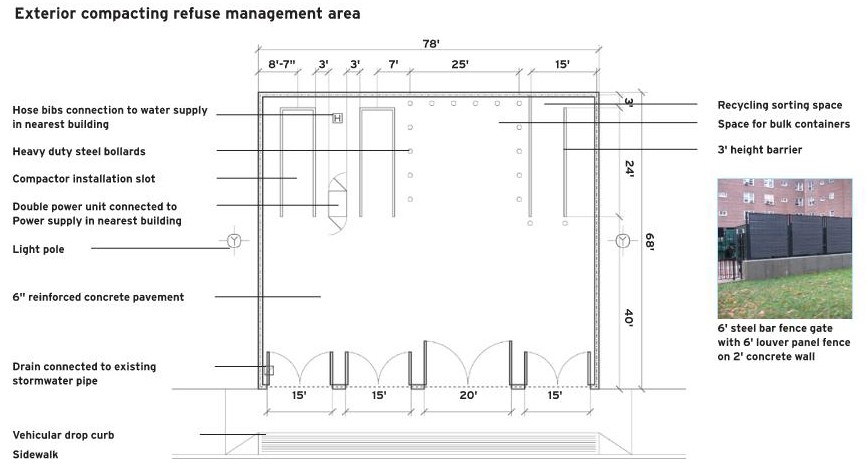
- Projects in this scope area may include repairing, replacing or installing new large compactors for trash and bulk and storage for recyclables located in a gated yard. This encompasses actions such as asphalt paving, entry gates and fencing, utilities for equipment, lighting, and CCTV. The full, detailed scope of work for this kind of project including any additional work areas are updated after alignment with project stakeholders through scoping and design activities.
- Design of exterior waste yards at NYCHA properties should consider the complete process of transferring, storing and removing trash and recycling from the development. Careful planning and attention to various factors such as location, storage requirements for recycling, and truck access for staff and DSNY trucks is critical. Waste yards should be strategically positioned to minimize noise and odor nuisances for residents while ensuring easy access for staff and DSNY. Adequate lighting and surveillance enhance security and deter unauthorized dumping and scavenging. Well-designed exterior compactor yards can improve working conditions for staff and the overall aesthetics and livability of open space, fostering a sense of community pride and enhancing the quality of life for residents.
Baseline
- Hydraulic compactors and open 30-yard containers utilized for bulk collection should be replaced by an auger compactor for combined household and bulk waste. The containers connected to the auger compactor will be collected by DSNY. Reference NYCHA specifications and the DSNY Roll On Roll Off Container Guide for minimum specifications and documentation required for equipment approval. [WM]
- Use NYCHA waste calculator to determine appropriate size of storage required to manage recyclables prior to collection. Ensure that recyclables storage is pest-proof and accessible to DSNY curbside collection trucks. Calculations and planned containerization must be confirmed with NYCHA Sustainability.
- All new mechanical equipment (exterior compactor, baler, etc.) must be compatible with Building Management Systems (BMS). [SA]
- Provide auger compactor or enclosed storage for cardboard collection. [SA]
- Provide storage for all recycling streams including organics, mattress and e-waste.
- Minimize the number of waste yards and minimize gates and curb cuts at sidewalks for pedestrian safety.
- Follow Department of Sanitation (DSNY) guidelines and provide NYCHA standard lighting.
- Use 8 foot fencing and gates to screen compactor areas.
- Increase the capacity of recycling centers to accommodate and to reduce contamination between waste streams. Refer to the Zero Waste Design Guidelines.
Stretch
- Where community gardens are adjacent the waste yard, leverage construction to provide hose bib and electrical outlet on the exterior of the waste yard accessible to gardeners.
- Provide wayfinding signage and clear communications elsewhere on the property for residents to get household trash, recyclables, and bulk waste to their proper destination. [SA]
- Consider the fencing of a waste yard as the perimeter system that residents and/or the general public interact with. Provide enhancements to the fence’s design or features (is there a shade structure built in with adjacent seating? Can the fence be visually appealing for a nearby garden? etc.).
- Designate storage at the perimeter of the waste yard for use by resident groups or community-based organizations, with independent access from outside the waste yard.
- Coordinate waste yard design with open space master planning and other grounds improvements. Reference the Connected Communities Guidebook and engage residents to incorporate color, graphics and text to improve aesthetics and wayfinding.
RAD Conversions
- If a property hosts exterior waste equipment used by other developments, the RAD Conversion Partner must continue to provide access to the shared equipment.
- If a property uses shared exterior equipment at a development retained by NYCHA, the RAD Conversion Partner must install and maintain its own exterior equipment.
- Reference and complete the NYCHA Waste Management Handover Document and NYCHA Waste Calculator.
Additional Reference Materials
Relevant Codes & Regulations
Strategies

Promote Safety and Security of Residents & Staff

Optimize Performance, Operation & Maintenance of Buildings, Systems & Assets
RADSustainability AgendaConnected Communities
Last Updated on January 10, 2026 at 2:27 pm
Downloads and Data
Specifications
NYCHA Waste Management Handover Guide
NYCHA Waste Calculator - 2.5

Diagrams
Details
A-DT_6sbf_conn_gate

A-DT_20 foot wide double gate in curb
A-DT_Compactor and Bulk Pre-Crusher Layouts
A-DT_gate15
A-DT_gate15_flush

A-DT_gate20_flush
A-DT_gate20_reveal
A-DT_gatepost connection
A-DT_louver_3_curb
A-DT_louver_3_wall
A-DT_louver_6_wall
A-DT_louver_conn_fence
A-DT_louver_conn_gate
A-DT_louver_conn_gate2
A-DT_louver_conn_gate3
A-DT_louver_flush_curb
A-DT_louver_masonry_conn
A-DT_louver_wall_filler
A-DT_raised_conc_pad
A-DT_Recycle
A-DT_Recycle with Trash
A-DT_wall_louver_form_free standing
A-DT_wall_louver_noform_free standing
A-DT_2017_Crusher_Title Block_1
A-DT_Bulk Crusher Detail
A-DT_Bulk Crusher_Single_Typ
A-DT_cart
A-DT_Compactor and Bulk Pre-Crusher Layouts
A-DT_Ext. Compactor Single Typ
A-DT_wear strips for Cram-a-Lot Compactor
E-DT_E001_Exterior Compactor_Electrical Diagram
E-DT_E001_Exterior Compactor Electrical - Block Diagram
E-DT_Elect_hookup for compactor
E-DT_pwr_encl_both
E-DT_pwr_encl_single
A-DT_Sign_on_Fence Play Equipment